
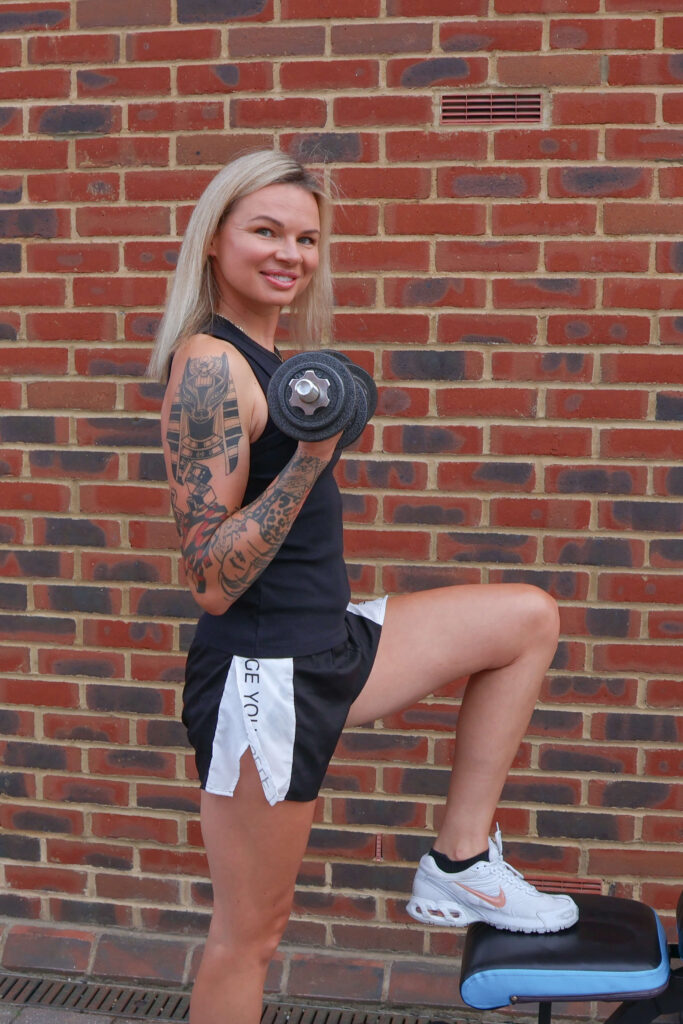
If you’ve heard that strength training is one of the best things you can do for PCOS — you heard right!
✅ It helps improve insulin sensitivity
✅ Builds lean muscle
✅ Supports hormone balance
✅ Boosts metabolism
✅ Improves mood and energy
But… here’s the problem: many women with PCOS start lifting weights and quickly burn out, feel too fatigued, or give up entirely.
Why? Because most generic training programs ignore the unique challenges of PCOS:
❌ Energy fluctuations
❌ Irregular cycles
❌ Increased inflammation
❌ Higher stress hormones (hello, adrenal fatigue!)
❌ Poor recovery during certain phases
That’s why it’s so important to start strength training with a plan that works for your body, not against it. One that prioritizes long-term consistency, not short-term exhaustion.
In this article, I’ll show you exactly how to build a sustainable strength training routine that fits your current fitness level, matches your energy, and supports your hormones — so you can get results and actually enjoy the process.
Step 1: Start with What You Can Do Now
One of the biggest reasons women with PCOS struggle to stick with strength training is starting too hard, too fast — often following generic plans or copying advanced routines from the internet.
The truth? What works for YOU is what will be sustainable.
And the best way to find that out is to get personalised guidance — so you’re not just guessing or poking around from workout to workout.
🔍 Ask yourself:
✅ What is my current energy like most weeks?
✅ How many days do I realistically have for training?
✅ Do I feel more comfortable at home or in a gym?
✅ What equipment do I have (or can easily access)?
✅ Do I want expert guidance to help me stay motivated and track my progress?
🏋️ Start small — but consistent:
👉 1–2 full-body sessions per week is often the perfect start — especially if you’re new to lifting, dealing with fatigue, or balancing an irregular cycle.
👉 Bodyweight, resistance bands, small weights (even water bottles!) — these can all be incredibly effective when starting out. You don’t need fancy equipment.
👉 15–30 minutes is enough — short, manageable sessions help build the habit first. Intensity comes later.
🌟 PCOS Coach tip:
Personalised advice can make a huge difference in motivation and results.
When you know your plan fits YOUR body and your PCOS type, you’re much more likely to stay consistent — and less likely to burn out or give up.
👉 Ready to get started? Book a free consultation here — let’s create a plan that’s right for you!
Step 2: Pick the Right Exercises
When starting strength training for PCOS, it’s easy to overcomplicate things — but the basics work best. The goal is to build strength, support hormone health, and balance blood sugar — not to exhaust yourself with random high-intensity workouts.
The best way to do that? Focus on full-body movements that train your entire body in just a few key exercises.
🏋️
5 Movement Patterns to Build Your Plan:
✅ 1. Squat pattern — bodyweight squat, goblet squat, chair sit-to-stand
✅ 2. Hinge pattern — hip thrust, glute bridge, deadlift
✅ 3. Push pattern — push-ups, incline push-ups, overhead press
✅ 4. Pull pattern — band pull-aparts, rows, resistance band pulls
✅ 5. Core stability — dead bugs, bird dogs, planks
🎯
How to structure a workout:
👉 Pick 5–6 exercises (one from each pattern — or repeat a lower body if needed)
👉 Do 2–4 sets of each exercise
👉 Aim for 10–20 reps per set — depending on your current fitness and how your body is feeling
👉 Rest 45–90 seconds between sets
🌟 Why this works:
- Strengthens large muscle groups
- Supports insulin sensitivity
- Builds lean muscle
- Boosts metabolism
- Balances hormones — without burning you out
🔍 PCOS Coach tip:
You don’t need dozens of fancy exercises!
For most women with PCOS, focusing on these 5 movement patterns, in a full-body workout 2–3x per week, is far more effective (and sustainable) than doing random exhausting circuits.
Need help designing your first routine? Book your free consultation — we’ll build something that works for YOUR body and YOUR goals.
Step 3: Train for Consistency, Not Exhaustion
This is where many women with PCOS run into problems:
They start off super motivated… hit 5 sessions the first week… and by week 3, they’re burnt out, inflamed, and frustrated.
Or… they expect quick fixes — doing 2 weeks of strength training, not seeing instant results, and jumping straight into endless cardio instead.
🚨 The truth is:
PCOS bodies need time to adapt
With strength training, noticeable results like improved energy, better cycle regularity, mood improvements, and body composition changes can take 4–6 weeks of consistent training.
Too often, women give up too soon and switch to high-intensity cardio — which can spike cortisol and actually stall progress in PCOS.
🎯 How many sessions per week?
For most women with PCOS, a great starting point is:
✅ 2–3 full-body strength sessions per week
✅ 1–2 optional low-impact movement days (walking, yoga, Pilates)
🏋️ How long should sessions be?
✅ 15–30 minutes when starting out
✅ Build up to 30–45 minutes if energy allows
✅ Focus on quality over quantity — good form, proper rest, and a calm nervous system
🚫 What to avoid:
❌ Pushing through exhaustion on low-energy days
❌ Doing back-to-back HIIT or intense circuits
❌ Expecting a “quick fix” — PCOS progress takes patience
❌ Switching to endless cardio too soon — this can backfire!
🌟 PCOS Coach tip:
Your goal should be to feel stronger, more balanced, and more energised over time — not wiped out after every session.
Progress comes with consistency — not from smashing yourself for 2 weeks and burning out.
👉 Want a plan that supports long-term results? Book a free consultation — I’ll help you build one.
Step 4: Track Wins Beyond the Scale
If there’s one thing I see over and over in my coaching:
Women with PCOS often give up on strength training because the scale doesn’t move fast enough.
But here’s the truth: your body is changing in ways the scale can’t always measure — especially in the first 1–2 months of consistent strength training.
And another key fact: the scale will move — but first, you need to get your hormones on track.
If your cortisol is constantly elevated, or if your body is inflamed and stressed, fat loss won’t happen — no matter how many workouts you do.
That’s why tracking your overall progress — not just your weight — is crucial.
🎯 What to track:
✅ Strength gains
• Are you lifting more weight?
• Doing more reps?
• Feeling more confident in movements?
✅ Energy & mood
• More consistent energy?
• Fewer crashes? Better sleep and mood?
✅ Cycle changes
• More regular periods?
• Less bloating, fewer PMS symptoms?
✅ Body composition
• How do your clothes fit?
• Changes in body shape or muscle tone — even if the scale is slow?
✅ Stress & recovery
• Is your body handling stress better?
• Improved recovery after workouts?
🌟 PCOS Coach tip:
Your hormones drive your results — not your willpower.
If your cortisol is through the roof, or your body is inflamed, no amount of cardio or calorie-cutting will move the scale in a healthy way.
But when you focus on getting stronger, managing stress, and training consistently — the fat loss will come, and it will be sustainable.
👉 Want help tracking the right markers (not just the scale)?
Book a free consultation — I’ll show you how.
Tips for Long-Term Progress
By now, you’ve seen that strength training for PCOS isn’t about doing more — it’s about doing the right things consistently and giving your body time to respond.
But how do you make this work long term — so you don’t burn out or give up after a few weeks? Here’s how:
🎯 1️⃣ Focus on progressive overload — slowly
Progressive overload means doing a little more over time — either more reps, more weight, better form, or more time under tension.
You don’t need to “go hard” every week. Small improvements lead to big results.
🎯 2️⃣ Prioritise sleep and recovery
💤 Sleep is where hormones rebalance. If you’re training hard but sleeping badly, your results will stall.
Aim for 7–9 hours of good quality sleep, and give yourself full rest days each week.
🎯 3️⃣ Train through ALL your phases — but adjust
Don’t skip strength training during your menstrual or low-energy phases — just adapt it. Lower volume, lighter weights, more mobility.
This signals consistency to your nervous system and prevents big drops in strength between phases.
🎯 4️⃣ Don’t compare yourself to others
Women with PCOS often progress at a different rate than women without it — especially when stress, fatigue, or hormonal shifts are high.
Focus on YOUR progress, your cycle, your body.
🎯 5️⃣ Expect fluctuations — and stay consistent
Some months will feel easier than others.
You might hit a great flow in one cycle, and feel flat in another. That’s normal. The key is to stay consistent — even when it’s not perfect.
🎯 6️⃣ Habit stack — make it part of life
Link your training with other habits (e.g. gym bag packed after your morning coffee).
The easier it is to show up, the more consistent you’ll be.
🌟 Final Coach tip:
The BEST results I see with my PCOS clients?
Not the ones who go “all in” for 4 weeks…
It’s the women who stay steady for 6 months+ — building strength, balancing hormones, and feeling stronger inside and out.
👉 Want a plan that helps you do exactly that?
Book a free consultation or check out my PCOS strength plans and nutrition guides.
Let’s make your progress sustainable — and effective.
Conclusion: Build Strength That Supports Your Hormones
Strength training is hands-down one of the most effective ways to manage PCOS — but it’s not about pushing harder or faster.
It’s about building a plan that:
✅ matches your current energy
✅ works with your hormones
✅ prioritises recovery
✅ focuses on strength and confidence
Give your body time to respond — because when your hormones are balanced, fat loss, mood, energy, and cycle health will follow.
Stay consistent, train smart, and trust the process. You’ll feel stronger, leaner, and more in control with every cycle.
👉 Ready to start?Book a free consultation — let’s build your personalised PCOS training plan.👉 Or browse my PCOS training & nutrition programs — designed for YOU.